
Currently Empty: $0.00

 4x Braided Line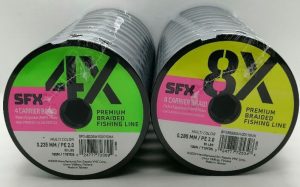
When it comes to choosing the right braided fishing line, most anglers eventually face the same decision: 4 strand vs 8 strand braid. Both are forms of PE braided line, but their performance, texture, and durability can vary drastically. Picking the right one can come down to where you fish, what you target, and how much you care about things like noise, abrasion resistance, and casting distance.
What Is a Braided Line Strand Count?
The strand count refers to the number of individual fibers woven together to create the main braided line. A 4 strand braid is made with four individual fibers, while an 8 strand is made with eight. This number directly affects the line’s feel, roundness, durability, and smoothness.
Main Differences Between 4 Strand and 8 Strand Braid
Here’s a breakdown of how the two compare based on key features:
| Feature | 4 Strand Braid | 8 Strand Braid |
|---|---|---|
| Durability | High abrasion resistance Good for rough cover | Less durable against sharp structures |
| Smoothness | Rougher texture, more friction | Smoother and softer Better for casting |
| Noise in guides | Louder through rod guides | Quieter, softer glide |
| Roundness | More flat or oval in shape | More round Improves casting and accuracy |
| Cost | Generally cheaper | More expensive due to complex weaving |
| Strength per diameter | Lower, stiffer build | Higher strength-to-diameter ratio |
Advantages of 4 Strand Braided Line
- Superior toughness when fishing near rocks, timber, docks, or shells
- Lower cost makes it a solid budget choice for heavy cover fishing
- Stiffer and easier to manage for flipping, pitching, or frog setups
- More resistant to sudden breaks from abrasion
Because of its coarse structure, 4 strand braid grips water more and creates friction in the guides. You’ll feel more vibration and hear a grinding sound, especially on a windy cast. That’s not always bad — some anglers prefer that feedback.
Advantages of 8 Strand Braided Line
- Smoother casting experience with longer distance and less friction
- Glides quietly through micro guides or ceramic rings
- Feels softer in the hand, especially when tying knots
- Rounder profile reduces digging into the spool under tension
For open water, finesse presentations, or spinning reels, most people lean toward 8 strand. It’s more forgiving on light gear, and smoother retrieval helps with sensitive bite detection.
When to Choose 4 Strand Over 8 Strand
If your fishing involves structure, heavy cover, or you’re working reaction baits in snaggy zones, 4 strand is the better bet. You trade off some smoothness for raw durability. This is especially useful when punching through mats, fishing submerged wood, or dragging a jig along rocky bottoms.
When to Choose 8 Strand Over 4 Strand
On spinning reels or when finesse fishing in open water, 8 strand takes the edge. It casts better, handles smoother, and doesn’t grind against guides. You’ll feel subtle bites better and make longer, quieter presentations.
Things Most People Don’t Talk About
- Knot strength on both types is mostly dependent on technique, not just the strand count
- Color retention tends to fade fast on both unless you’re using high-end coatings
- Some brands offer hybrid weaves or even 12 strand braids, but those often come with a steep price
- Not all 4 strand or 8 strand braids are created equal, brand quality still matters more than strand number
Which One Lasts Longer?
4 strand braid generally lasts longer in tough conditions. It takes more abuse and is less likely to fray. But 8 strand can hold up well too if you avoid contact with sharp debris or heavy structure. Frequent retying and maintaining your line will make more difference than strand count alone.
Final Thoughts
Neither one is strictly better than the other. The 4 strand braid gives you toughness and abrasion resistance. The 8 strand braid offers smoothness and distance. Match your line to your environment and technique instead of chasing numbers. Both have their place in a well-rounded tackle setup.

